

IELTS ACADEMIC WRITING RESOURCES
IELTS Academic Writing Task 1 and 2 (D73)
Sample answers, useful vocabulary, collocations and planning support.
Writing Task 1
Spend about 20 minutes on this task.
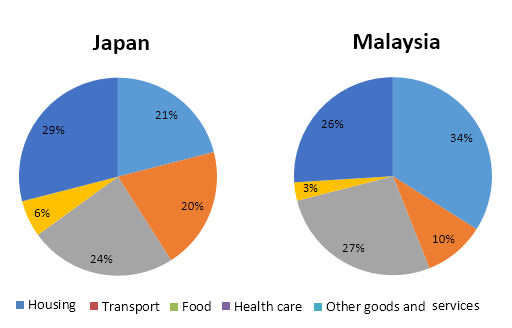
The pie charts below describe average household expenditures by major categories in Japan and Malaysia in 2010.
Summarise the information by selecting and reporting the main features, and make comparisons where relevant.
Write at least 150 words.
SAMPLE ANSWER — TASK 1
The two pie charts illustrate the proportion of household spending across major categories in Japan and Malaysia in 2010.
Overall, while both countries allocated the largest share of their expenditure to housing, notable differences can be observed in the distribution of spending on food, transport, and other categories.
In Malaysia, housing accounted for the highest proportion at 34%, followed by food at 27%. Transport represented 10%, while health care and other goods and services made up relatively smaller shares at 3% and 26% respectively. This suggests that Malaysian households prioritized basic necessities such as accommodation and food.
By contrast, Japanese households devoted a slightly smaller share to housing, at 21%, but a much larger proportion to transport (20%) and other goods and services (29%). Food expenditure was 24%, similar to Malaysia, while health care represented a more significant share at 6% compared to Malaysia’s 3%.
In summary, although housing was the largest category in both countries, Malaysian households spent more heavily on food, whereas Japanese households allocated more to transport and health care. This reflects differences in lifestyle and cost structures between the two nations.
Useful vocabulary and phrases for Task 1
- accounted for / represented / comprised / constituted
- the largest proportion / the highest share / the dominant category
- by contrast / whereas / in comparison / on the other hand
- a relatively small share / a significant proportion / a notable difference
- prioritized / allocated / devoted spending to
Writing Task 2
Spend about 40 minutes on this task.
Write about the following topic:
Some people say that the current level of air travel is acceptable whereas other people believe air travel should be reduced and the government should play a role in this. Discuss both sides and give your own opinion.
Give reasons for your answer and include any relevant examples from your own experience or knowledge.
Write at least 250 words.
MODEL ESSAY — TASK 2
Introduction
Air travel has become an integral part of modern life, connecting people across continents and supporting global trade and tourism. While some argue that the current level of air travel is acceptable, others believe it should be reduced due to environmental concerns, with governments playing a regulatory role. This essay will discuss both perspectives before presenting my own opinion.
Arguments for acceptable levels of air travel
Supporters of maintaining current air travel levels highlight its economic and social benefits. Aviation facilitates international business, tourism, and cultural exchange, contributing significantly to national economies. For many individuals, air travel is the most efficient means of visiting family or pursuing educational opportunities abroad. Furthermore, technological advancements in aircraft design have made flights safer and more fuel-efficient, reducing some of the environmental impact compared to earlier decades.
Arguments for reduction
On the other hand, critics emphasize the environmental consequences of widespread air travel. Aircraft emissions contribute to climate change, and the industry’s reliance on fossil fuels makes it a major source of greenhouse gases. Additionally, the expansion of airports often disrupts local communities and ecosystems. From this perspective, governments should intervene by promoting alternatives such as high-speed rail, imposing taxes on frequent flyers, or investing in sustainable aviation technologies to mitigate the damage.
Conclusion — opinion
In my view, while air travel is essential for global connectivity, its environmental impact cannot be ignored. Rather than drastically reducing flights, governments should adopt a balanced approach: encouraging innovation in green aviation, supporting alternative transport modes, and implementing policies that discourage unnecessary travel. This way, societies can continue to benefit from air travel while addressing its long-term sustainability challenges.
Vocabulary: supporting current air travel
- Global connectivity: international links, worldwide integration, cross-border exchange
- Economic benefits: boost to national economies, revenue generation, tourism growth
- Cultural exchange: fostering international understanding, promoting diversity, global interaction
- Efficiency: time-saving, rapid transportation, convenient mobility
- Technological advancements: fuel-efficient aircraft, improved safety standards, innovation in aviation
Vocabulary: supporting reduction
- Environmental impact: carbon emissions, greenhouse gases, ecological footprint
- Climate change contribution: global warming, rising emissions, unsustainable practices
- Government intervention: regulatory measures, policy enforcement, legislative action
- Alternative transport: high-speed rail, sustainable mobility, eco-friendly options
- Social consequences: community disruption, noise pollution, land-use conflicts
Academic collocations and synonyms
- play a regulatory role
- impose taxes on frequent flyers
- promote sustainable aviation technologies
- encourage innovation in green transport
- balance economic growth with environmental protection
- facilitate international trade and tourism
- mitigate environmental damage
- adopt a balanced approach
Useful synonyms: acceptable — reasonable, justifiable, permissible; reduce — curtail, diminish, limit, restrict; important — significant, crucial, vital, essential; negative — detrimental, harmful, adverse, damaging; positive — beneficial, advantageous, constructive, favourable.